ORGANISATIONAL DESIGN – A FUTURE PERSPECTIVE
Revised Publication: Originally published with the International Orgtology Institute (IOI) on 5 December 2020 under the same title by Derek Hendrikz.
From an Orgtology perspective, Org is best understood not as a chart, but as a living system of coordinated activity—an externalised, collective intelligence that stabilises what must repeat and mobilises what must change. Because purposeful activity pulls resources toward it, design should begin with the flow of activity. Activities are the building blocks of organisation. They contain tasks, rules, procedures, accountability, responsibility, time, resources, risks, cost, and other critical information. Once one understands the flow of activity, then we can shape the Org structures that gives human accountability to those flows. Put differently, in Orgtology this dual demand is expressed as purpose and intent, or receptive and projective elements: because coordinated activity must be both repeatable enough to perform (purpose) and adaptive enough to remain relevant (intent), organisational design must hold an equilibrium between Org’s receptive and projective elements.
Org as collective intelligence (why design matters)
Without organisations, human capability would remain fragmented and local. Org is how humanity “stores” and coordinates intelligence across time, through rules, roles, routines, and shared meaning. It is not intelligence in a biological sense, but it behaves like an externalised intelligence: it remembers, standardises, scales, and learns through its people and systems.
From an Orgtology perspective, this is why organisational design is not “drawing structures.” It is the deliberate shaping of how activity becomes coordinated effect—so the organisation can perform (today) and remain relevant (tomorrow).
Beyond this, the organisational design must manage a best point equilibrium (BPE) between its receptive and projective elements.
The inversion principle: nature vs Org (activity–resource logic)
A key Orgtology insight is that Org does not follow nature’s organising rule.
In nature, resources tend to shape activity. When resources change, evolution shifts. Activity follows the available fuel.
In Org, activity tends to shape resources. A purposeful activity (what the organisation chooses to do) pulls resources toward it—people, money, assets, data, and intelligence.
This inversion matters because it changes what “design” must focus on. If activity pulls resources, then design must begin with activity, not with the containers we place people in.
Purpose binds; intent directs (the two anchors of Org)
Orgtology differentiates two anchors that are often blended in conventional thinking:
- Purpose binds activity: it answers what must be done to perform and remain coherent as a system.
- Intent directs activity: it answers how we will stay relevant amid uncertainty and disruption.
A strong organisation is not only efficient in purpose, but also effective in intent. This is why organisational design must ultimately serve duality: the organisation must be stable enough to perform, and adaptive enough to remain relevant.
Org design as the blueprint of controlled flow
We design Org to make activity:
- predictable where it must be predictable (operations, repeatable work, resource flows), and
- adaptive where it must be adaptive (change, innovation, strategic movement, disruption response).
The Basic Assumption of Organisational Design
The design assumption: Org should be shaped around activity flow
If organisation happens through the movement and resourcing of activity, then organisational design should start by understanding:
- what activity must flow,
- what dependencies exist in that flow, and
- what resourcing must occur for flow to remain uninterrupted.
In other words: design follows flow, not the other way around. In Orgtology, the Level Zero model provides a generic basis for this logic.
Why organigrams often mislead
Most organisations treat the organigram as if it is the organisation. In Orgtology, an organigram is primarily a map of authority relations (who may decide, approve, control, escalate). That is useful, but incomplete.
The risk is that departments become mistaken for “real flow.” Departments often reflect:
- historical decisions,
- convenience groupings of similar skills,
- budgeting lines,
- control preferences,
rather than true activity dependencies.
Departments vs flow: when knowledge clusters distort movement
A department can be a cluster of expertise (e.g., HR), but expertise clustering is not the same as activity flow.
For example:
- Recruitment, procurement, and budgeting all serve the resourcing of Org, yet they often sit in separate silos.
- Performance assessment, internal auditing, and accounting share a retrospective logic (they assess the past to secure a relevant future), yet they are usually designed as unrelated streams.
Orgtology’s warning is simple: focus can distort form. If you only look at Org through departmental focus, you will misread the organisation’s true shape.
The Orgtology position: one process, many dissections
From an Orgtology perspective, any organisation has one integrated process emanating from purpose. What we call “many processes” are usually dissections of the one, done for human manageability.
This is why design work must repeatedly return to the question:
“How does the organisation’s core activity unfold end-to-end across people, systems, decisions, and entities, and how does this unfolding integrate relationships, operational efficiency, and strategic effectiveness into a coherent symbiotic whole?”
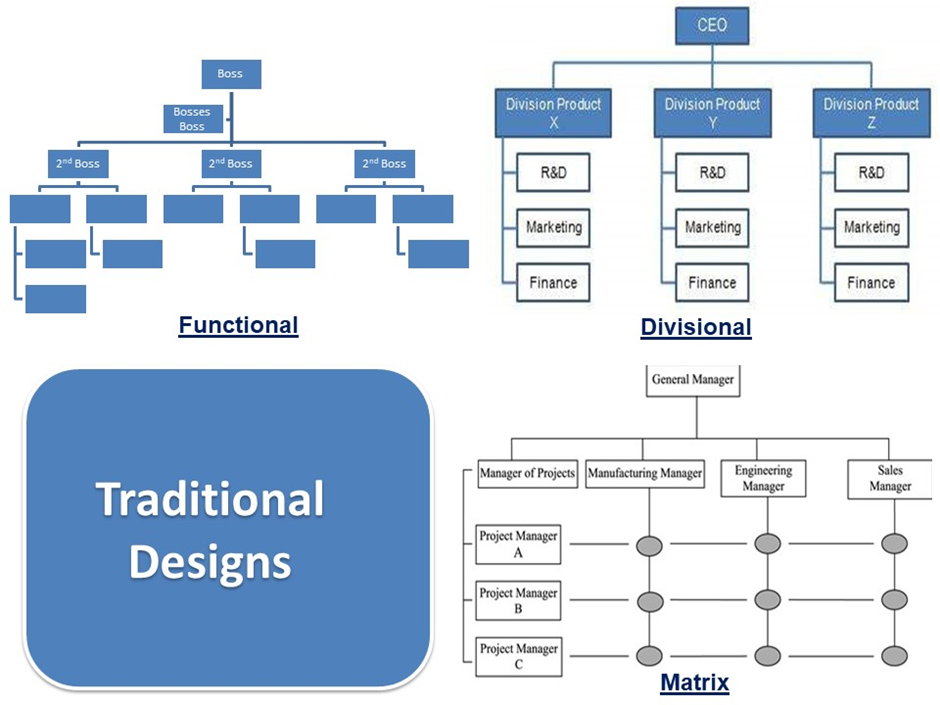
Traditional Organigram Designs
Two maps, one organisation: authority vs activity
Here the tension becomes visible:
- Organigram logic: authority, control, accountability, reporting lines.
- Process-flow logic: efficiency, dependency, throughput, handovers, delays, rework.
Both are real, but they answer different questions. Problems arise when Org assumes one map can do both jobs.
The classic design error: forcing activity into authority boxes
Traditional process engineering often designs flow “inside” the organigram—assuming activity should conform to reporting lines. In Orgtology, this is usually flawed because flow rarely respects authority boundaries.
This creates predictable inefficiencies:
- duplication of effort across departments,
- delays at departmental borders,
- competing local optimisations (each silo “wins” while Org loses),
- hidden conflicts between what is efficient and what is controllable.
Why this matters even more in an AI-shaped world
As systems intelligence increases, inefficiency becomes less tolerable. Systems learn patterns quickly and expose contradictions: If an organisation repeatedly performs an inefficient sequence, it trains systems on that sequence.
Over time, systems will push toward the path of least waste and traditional structures struggle to justify waste.
This is one reason Orgtology anticipates a shift away from authority-centred design toward activity-centred design.
Reframing “the diagram problem”
The issue is not that organigrams are “wrong.” The issue is that they are overburdened—expected to represent authority, accountability, workflow, collaboration, knowledge flow, resourcing, and strategy all at once. Orgtology separates these realities and reintegrates them through duality – a ‘receptive vs projective’ lens.
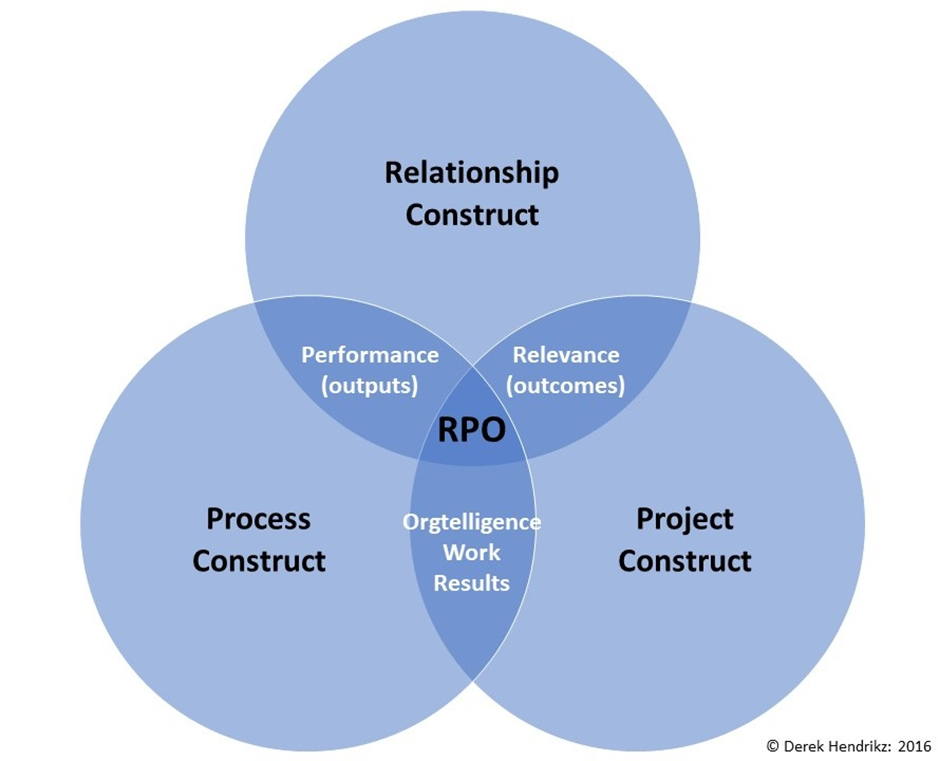
The Three Constructs of Org
Constructs vs structures
- A structure is tangible (e.g., a formal team, a committee, a reporting line).
- A construct is conceptual: it is the organising blueprint that makes structures coherent (e.g., a process flow).
Process construct: the blueprint of “run”
The process construct contains activity that repeats. It stabilises the organisation’s operational environment and enables efficiency. In Orgtology: it is the blueprint of how we run the organisation.
Project construct: the blueprint of “change”
The project construct contains activity that does not repeat in the same way. It exists to change the organisation—responding to disruption, creating transformation, and shaping future relevance. It is the blueprint of how we change the organisation.
Relationship construct: the blueprint of meaning and influence
The relationship construct is more abstract because relationship activity is less predictable than process activity. Yet it is decisive because it determines:
- what stakeholders accept as “performance,” and
- whether the organisation remains relevant.
Where relationship and process constructs intertwine, the organisation defines performance.
Where relationship and project constructs intertwine, the organisation defines relevance.
The RPO idea (why three constructs must coexist)
Together the three constructs form the Relevant and Performing Organisation (RPO):
- process gives operational stability,
- projects give adaptive movement,
relationships give meaning, legitimacy, and influence.
Level Zero: Flow Of Resources vs. Flow of Activity
Why we must separate activity-flow from resource-flow
Historically, organisations often treated activity and resources as one blended flow. Orgtology separates them because in a cyber-physical world:
- systems intelligence executes increasing portions of activity,
- teams become more fluid,
- boundaries become permeable,
- and “who reports to whom” becomes less predictive of “how work actually moves.”
The Level Zero logic (the generic genome of Org)
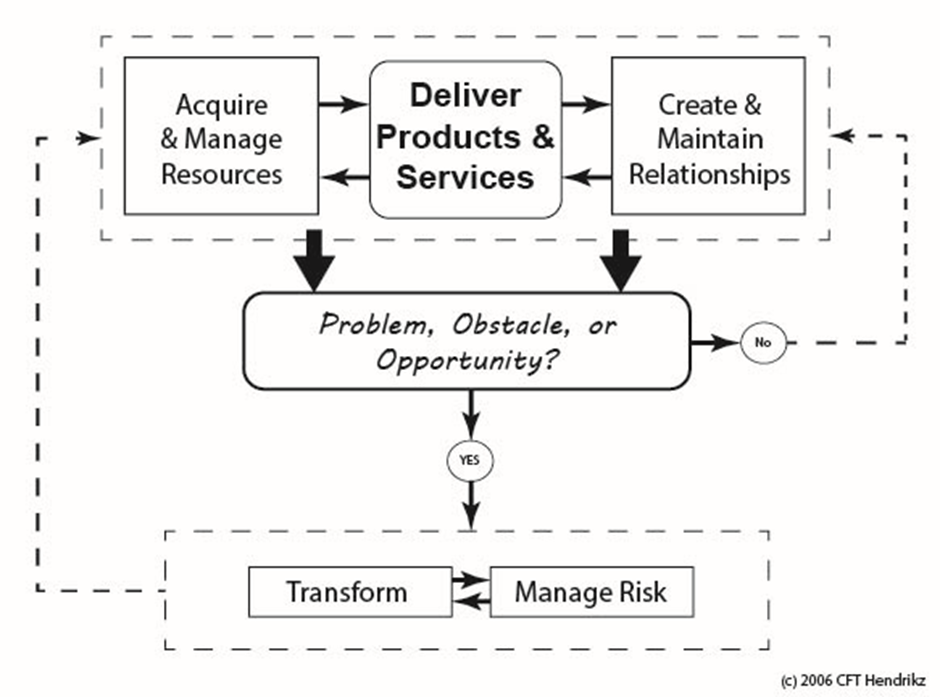
The Level Zero model represents a generic activity flow for any organisation.
At Level Zero, Org must always do five things:
- Efficiently resource itself (people, money, assets),
- Deliver on its negotiated or mandated core purpose (products/services),
- Relate meaningfully to stakeholders (customers, suppliers, regulators, employees, competitors).
- Reduce its risk exposure, and
- Transform
The first three items, resources, core business, and relationships form the (predominantly) receptive side of Org: the stabilising systems that allow repeatability and performance.
The last two items, risk and transformation, work with disruption, change, threats, and opportunities. The demand for transformation, innovation, risk management, and strategic shifts forms the (predominantly) projective side of Org.
Hypothesis 2x inside Level Zero (the duality signature)
Level Zero is not “a process map.” It is a duality map:
- receptive systems stabilise purpose performance,
- projective systems advance intent effectiveness,
- and the organisation must continuously manage the tension between the two.
Organigram of the Future
From divisions to teams: design around flow, not silos
As systems intelligence grows, the most viable organising unit becomes the team formed around activity flow rather than the division formed around authority. The future organigram is likely to be more network-like than tree-like, and more activity-defined than title-defined.
The blur: employment, membership, and multi-team reality
If teams form around processes/projects, then a person can belong to multiple teams simultaneously because they are a resource to multiple flows. This blurs departmental identity and classical separations in resourcing logic.
Why humans struggle to “draw” the future Org
As Org becomes more networked, it becomes less practical for human minds to map it accurately. Orgtology anticipates that systems intelligence will increasingly detect activity patterns, propose optimal sequencing, and represent organisation as a dynamic network.
Purpose & intent as the new centre of gravity
In the future organigram, the stable centre is not a hierarchy chart—it is:
- purpose (what must be done to perform), and
- intent (how we remain relevant).
- Teams then orbit these anchors through receptive stability and projective renewal.

The Relation Between Hypothesis 2x and Organisational Design
Hypothesis 2x: Org exists through duality
Hypothesis 2x frames Org as projective–receptive interaction:
- Operations are receptive (repeatable, measurable, controllable).
- Strategy is projective (adaptive, uncertain, negotiated, intent-driven).
This is a core Orgtology reframing: strategy is not a planning activity. It is organisational positioning in the projective realm—how the organisation chooses to move under uncertainty.
Design as the receptive architecture that makes strategy real
Organisational design shapes the receptive environment so operations perform efficiently (purpose) and the organisation can absorb strategic disruption without breaking.
Best Point Equilibrium (BPE): resourcing duality intelligently
Because the organisation must resource both receptive performance and projective relevance, it must find a Best Point Equilibrium (BPE)—a defensible best-fit balance of energy/resources invested in each side. In orgtology teaching, BPE is not necessarily mathematical; it is a reasoned equilibrium claim based on organisational context.
The X-factor: why strategy can’t be “controlled”
The X-factor represents human agency and unpredictability in the projective realm. Orgtology does not eliminate the X-factor; it designs receptive strength so the organisation can contain volatility, convert disruption into advantage, and prevent projective energy from overpowering operational sanity.
Strategy–operations tension is normal (design manages it)
In Orgtology, tension is evidence of life:
- too little projective tension leads to stagnation,
- too little receptive stability leads to chaos.
Design structures the organisation so duality remains productive.
Conclusion – Summarising the Future of Org Design
The Orgtology sequence for design (one coherent method)
To design Org, we must:
- Understand what Org is (activity + resourcing + meaning),
- Define what it must achieve (purpose and intent),
- Blueprint the flow (Level Zero logic and the three constructs),
- Build receptive strength (process reliability, role clarity, accountability),
- Enable projective movement (projects, strategic positioning, transformation capacity),
- Manage equilibrium (BPE) so Org remains performing and relevant, and
- Integrate with a conducive organisational culture.
Conscious evolution: why Org keeps changing shape
As activity flows it becomes more efficient in purpose; as it adjusts and redefines it becomes more effective in intent—this is how organisations grow and generate new organisational “consciousness.”
The future perspective (kept visionary, made precise)
The future organisation is likely to be increasingly cooperative and networked, integrating human intellect with systems intelligence.
Orgtology keeps this grounded:
- Purpose anchors what must be done to perform.
- Intent guides how the organisation stays relevant.
- Hypothesis 2x prevents collapse into either rigidity (all receptive) or chaos (all projective).
In short:
Org is how humanity coordinates survival and progress—through designed duality.
References:
- Hendrikz, D. (2020) ‘Organisational Design – a Future Perspective’, The International Orgtology Institute, 5 December. Available at: https://orgtology.org/index.php/2015-06-01-09-45-25/orgtology-blog/101-organisational-design (Accessed: 8 May 2026).
Orgtologist