

Measurement of Workplace Results – The Otology Perspective
By: Lule Richard
Introduction
The essay seeks to explain how theory 2E of results can be deployed in organization to promote efficiency and effectiveness in an organization. The essay will be presented in four parts i.e. Background to the Essay, the essay Hypotheses, Key Workplace Results measuring models, Theory 2E of Results, ways through which theory 2E of results improve workplace measurement, conclusion and references.
Background
Workplace results are the one single fundamental issue that an organization’s leadership and management team seek to define and control in absolute terms. Unfortunately, the available models and frameworks are still limited in measuring and explaining the relationship among organizational inputs, outputs, and outcomes (David A. 2015). This has continued to make it difficult for organizations to measure their day-to-day performance and negotiate their future (Hendrikz, D. 2019).
Organizations have devised and implemented performance measurement systems and frameworks but most of them are preoccupied with different Key Performance Indicators (KPIs) and metric systems (Aithal P. S & Shubhrajyotsna A, 2023). Most of the frameworks use metrics that do not reflect the desired outcomes and end up being bogged down in measuring irrelevant activities. The traditional frameworks emphasize metrics like output volume or hours worked, which don’t necessarily reflect the quality of work or employee well-being. Other frameworks focus solely on individual or team productivity, neglecting important aspects like employee engagement, innovation, or customer satisfaction. Lack of flexibility is another area of concern with the available framework. Current frameworks might struggle to adapt to the changing nature of work, particularly with the rise of remote work and the gig economy.
As much as the above frameworks may have several strengths and may have helped some organizations that implemented them to attain significant milestones they have tended to be skewed towards one element of the organization. Some frameworks focus on the operation side of the organization and tend to pay less attention to the strategic side of the organization. Organizations that have found themselves in such situations have efficient systems and are always high on performance. But often have misfired on the needs of the environment they serve and hence lose relevance that requires them to survive, and some Institutions are on the verge of extinction.
The organizations facing extinction in Uganda are the mission Health facilities. As per the Uganda Ministry of Health report, (2020), Mission Hospital contributes 10% of the total number of facilities in the country. These hospitals have been known for providing quality Health care in the country they have been the first choice as they have been known for having clear policies and procedures in patient care, over time they have remained static and failed to respond to the environmental demand and as a result private Institutions who have provided environmental based solutions are favoured irrespective of the fact that their services are accessed at a slightly higher cost.
The Mission Health Facilitation in consideration, have been in existence for over a hundred years, and for a very long time, they have been thriving on donations and funding from Europe and America. However, in the last twenty years, the donations and funds have reduced to zero. This required a paradigm shift and a strategy to translate their operation from donor-funded to a business approach. However, most of them have remained in donor-funded mode, in those same policies and procedures in terms of pricing the services offered, billing, customer care, and clinical and surgical procedures. They are still using the old technology to treat their patient. What is clear and unique to them is their outdated clear policies and procedures which they observe scrupulously.
Irrespective of their emphasis on the efficiency of their system the number of patients continuously dwindling and some Health specialists have left the Institutions for private Institutions that are considered to have upgraded equipment and flexible policies and procedures.
What is happening in the above case is a clear manifestation of the organization’s failure to balance between efficiency and effectiveness. Efficiency is doing things right while effectiveness is doing the right and relevant things as dictated by the environment that sponsors the Institution (Hendrikz, D, 2019). The Institution’s leadership and Management failure to attain the equilibrium between efficiency and effectiveness has resulted in skewed organizations. The above situation can be explained by the organisational approach which always promotes Hypothesis 2X which presupposes that organization aspects should be looked at in duality. In this case, workplace results measurement is the duality between effectiveness and efficiency with the theory of 2E of workplace results.
Hypothesises
Theory 2E of Results can improve the measurement of workplace results in an organisational setting.
Key Workplace Results Measuring model
For this essay, the review of the available workplace results measurement models will only be limited to the Balanced Scorecard and Performance Management framework. Below are the details:
Balanced scored Card framework
This is one of the popular frameworks for measuring workplace results currently. It was proposed by Kaplan & Norton (1992). The framework focuses on translating strategy into operational metrics. The assumption behind the balanced scorecard is that organizational results can be measured in four perspectives: financial, customer, internal processes, and learning and growth. Organizations that have adopted it, concentrate on developing Key performance indicators and associated metrics that only capture the operational matters.
The framework is in response to the traditional financial accounting measures like return on investment and earnings per share that give misleading signals for continuous improvement and innovation—activities today’s competitive environment demands. The traditional financial performance measures worked well during the industrial era, but they are out of step with the skills and competencies companies are trying to master today.
The design of the balanced scored framework measures tends to focus more on internal operations, from the organisational perspective, it focuses more on organization efficiency and less on external factors. This is specifically expressed under the customer care perspective. But this still is a narrow view of issues that need to be put into perspective for an organization to stay relevant. This still indicates that the balanced scorecard is still limited in measuring workplace results.
Performance Management Framework
A Performance Management Framework (PMF) is a structured system devised and implemented by the organization to guide the process of continuously improving individual, team, and organizational performance (Armstrong M, 2023). It establishes a clear path for setting goals, tracking progress, providing feedback, and developing employee skills. Organizations have different performance management systems; however, all of them seek to measure workplace results from the individual productivity level. The main objective is to establish how well individuals in the organization perform. The assumption is that the summation of individual staff in the organization influences the entire organization’s performance.
The central characteristics of the framework include alignment of individual performance with the overall clear organization objectives, clear metrics and Key Performance Indicators to guide performance, continuous feedback loop, continuous competence and skills improvements, and collection of data for administering both positive and negative organization rewards.
As much as performance management frameworks have been adopted by many organizations, they still have some drawbacks that prevent them from being a good alternative measure of workplace results. A key one is the framework orientation to individual performance, focusing on non-measurable KPIs, and oftentimes operational in nature. The skewed approach of the framework denies the capacity to give it a balanced measure of the organizational workplace results.
The desire to deal with the weakness associated with the current workplace measures dictated the birth of “Theory 2E of workplace results.
Theory 2E of Results
Theory 2E of understanding workplace results was proposed by Derex Hendrikz. The theory provides for measuring the outputs and outcomes of the organization. The theory probes, the results of the organization’s operations, and its strategic initiatives. Theory 2E is a subset of Hypothesis 2X, where 2E explains the two organizational aspects i.e. efficiency and effectiveness that must be in equilibrium to get a performing and relevant organization. Efficiency represents receptive and effectiveness represents the projective measures of the organization.
The main assumption behind Orgtology’s Theory 2E of Results is that achieving organizational success requires a balance between efficiency and effectiveness. Efficiency is about doing things right (Peter F. Ducker, 1967). It involves minimizing waste and maximizing outputs for the chosen tasks. Effectiveness is doing the right things. It involves focusing on activities that truly contribute to achieving the organization’s relevant goals (Hendrikz, D, 2019).
According to Orgtology, a successful organization needs to achieve a balance between these two aspects. Just focusing on efficiency without considering effectiveness can lead to wasted effort on activities that don’t contribute to the bigger picture of the organization. Conversely, neglecting efficiency can lead to wasted resources and slow progress even if you’re focused on the right and relevant goals.
Theory 2E demonstrates two metrics that can be used to give a balanced view of the organization for today and the future. i.e. Efficiency and effectiveness. Below are the details of each matrix recommended.
Efficiency (Output) Measures
The measures under this category focus on the relationship between inputs and output. These measure the conversion rate of inputs to outputs. An efficient organization is that one uses fewer inputs with high outputs. This implies inputs play a great role in the quality and quantity of outputs. Theory 2E also recognizes the role of inputs in the measure of organizations’ outputs. You can only know how efficient your processes are against your inputs. Therefore, the output measure of workplace results as per theory 2E focuses on the receptive measure of the organization which may constitute elements like:
- Process cycle completion
- Time efficiency
- Cost efficiency
- Target Achievement
Effective (Outcome) Measures
The measures under this category focus on the impact of the outputs in the sponsoring environment. The voting of the outputs in the environment measures the effectiveness of the organization. The effective (outcomes) measures probe the relevance of the organization’s outputs from the environment. Outcomes measure the workplace results as per the theory 2E focuses on the projective elements of the organization which may broadly constitute elements like:
- Project Impact
- Achievement of Goals
- Changes in the demand partners of the organizational outputs
- Customer Satisfaction
The efficiency and effectiveness measures must be crafted in the entire, measurement framework of any organization. Where efficiency is very high but very low on effectiveness is a clear indicator of quick organization death. Organizations low on both effectiveness and efficiency are an indication of slow death. High effectiveness and low efficiency is an indication of survival. High efficiency and high effectiveness is an indication of thriving. Figure 1 below, explains organizations should view their workplace results to ensure continued performance that is empowered by relevance of outputs in the operational environment.
Fig 1: Workplace Results
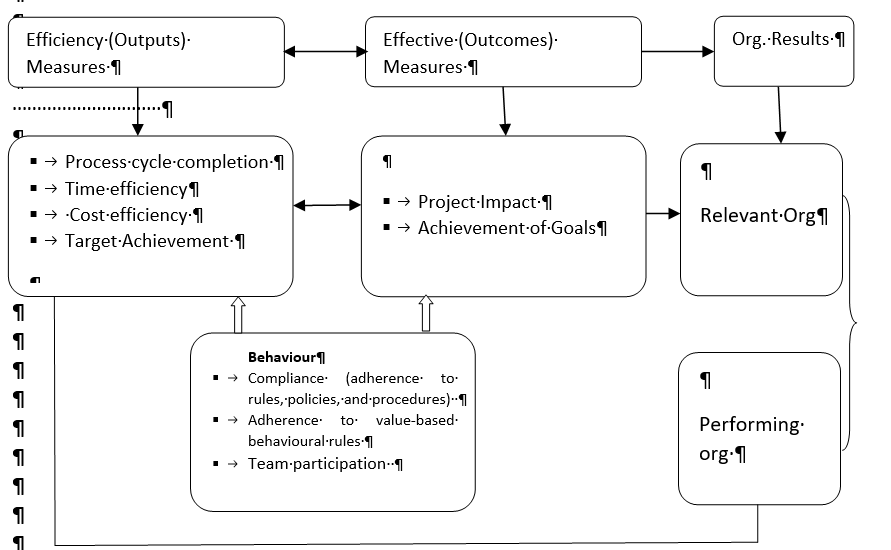
The model seeks to explain the aspects that are used in the methodology of orgtology to get an organization that is both relevant and performing at the same time. The conceptual framework above indicates that an organization should measurement is complete when three things are measured. This involves efficiency (Outputs), effectiveness (outcomes) and behaviours. Efficiency is measured through the process outputs. The best methods for measuring outputs are the targets that can take the form of time efficiency, and cost-effectiveness. Targets are the best because they are within the organization’s control and can be predicted. The other measure that must co-exist with the efficiency is the effectiveness. This is measured through outcomes, and it is measured through goals attainment and impact caused by the organization’s outputs. This is because goals and impact are futuristic in nature and are after negotiating organization relevance. However, efficient and effective measures are both empowered by the intervening behavioural measure.
These always come in to ensure organization operations are in harmony with the operational environment. It looks out for issues like compliance with the applicable laws, values and beliefs. The interplay of efficiency, effectiveness and behaviours will result in a performance and relevant organization.
Ways through which Theory 2E of results improve workplace measurement
The comparative analysis of the available workplace measurement and theory 2E of Results (Orgtology’s Theory) can improve workplace measurement in several ways and some of them may include.
The framework has refocused the measures on issues that matter for organisational performance and relevance. Theory 2E encourages moving beyond simply measuring activity (e.g., number of calls made) to focus on the outcomes of that activity (e.g., customer satisfaction). This helps to ensure that workplaces are measuring what truly matters and identifying if processes are effective in achieving their goals.
The theory enforces a balanced approach to measurement by considering both Efficiency (doing things right) and Effectiveness (doing the right and relevant things): and encourages the measurement of metrics that capture both aspects of workplace performance. This prevents an over-emphasis on speed or output at the expense of quality or impact.
The system quickly Identifies Areas for Improvement. Analyzing both efficiency and effectiveness data can help to identify weaknesses in workplace processes. This allows for targeted interventions to improve specific aspects of work, rather than wasting time and resources on general improvements that may not be necessary.
The theory can improve an organization’s decision-making process. Data on efficiency and effectiveness can inform decision-making about resource allocation and process improvement. This enables data-driven decisions that can lead to better workplace performance.
In summary theory 2E of results can influence the available measures in the fours as outlined in the matrix below:
Matrix 1: Workplace Measure Improvement
| Aspects of workplace measurement | Improvement with theory 2E |
| Focus | Focus moves beyond out to outcomes |
| Balance | Considers both efficiency and effectiveness |
| Improvement Identification | Enables targeted Improvement |
| Decision making | Informs data-driven decisions |
However, the key challenge of theory 2E of results is specifically with quantifying outcomes measures. This is because the organization has little or no control and also the aspects being measured have to do with people dynamics that can be manifested in feeling, satisfaction and mood. This is further empathised by the X-factors of hypothesis 2X which is unpredictable and the abstractness part of human nature that works in the organization.
Conclusion
The information reviewed regarding the assumptions of Theory 2E of results indicates its high potential to improve the measurement of workplace Results in an organization setting. The theory provides a framework for measuring what truly matters in the workplace, leading to more meaningful insights and improved outcomes.
References
- Hendrikz, D (2019). ‘Theory 2E – Understanding Workplace Results‘, The International Orgtology Institute, 29 September. Available at https://orgtology.org – Essays. Click here for link – accessed on 13 May 2020.
- Hendrikz, D (2019). ‘Theory 2P – Understanding Work‘, The International Orgtology Institute, 14 September. Available at https://orgtology.org – Essays. Click here for link – accessed on 25 May 2020.
- Hendrikz, D (2020). ‘Hypothesis 2x – the Foundation of Orgtology‘, *The International Orgtology Institute, * 04 April. Available at https://orgtology.org – Essays. Click here for link – accessed on 10 May 2020.
- Hendrikz, D (2020). ‘Theory 2I – Understanding Orgtelligence‘, The International Orgtology Institute, 25 September. Available at https://orgtology.org – Essays. Click here for link – accessed on 25 February 2020.
- Peter F. Drucker, (2006) The Effective Executive: The Definitive Guide to Getting the Right Things Done (Harper Business Essentials)
- Armstrong M, (2023) Handbook of Human Resource Management Practice: A Guide to the Theory and Practice of People Management 16th Edition
- Uganda Ministry of Health Report (2019) National Health Facility Master List. A Complete List of all Health Facilities in Uganda
- David A. (2015), Getting Things Done. This productivity classic outlines a system for capturing, clarifying, organizing and completing tasks.
- ROLE AND IMPORTANCE OF KEY PERFORMANCE
- INDICATORS MEASUREMENT
- ROLE AND IMPORTANCE OF KEY PERFORMANCE
- INDICATORS MEASUREMENT
- ROLE AND IMPORTANCE OF KEY PERFORMANCE
- INDICATORS MEASUREMENT
- ROLE AND IMPORTANCE OF KEY PERFORMANCE
- INDICATORS MEASUREMENT
- Aithal P. S & Shubhrajyotsna Aithal ( 2023) Key Performance Indicators (KPI) for Researchers at Different Levels & Strategies to Achieve it
- LE AND IMPORTANCE OF KEY PERFORMANCE
- INDICATORS MEASUREMENT
- ROLE AND IMPORTANCE OF KEY PERFORMANCE
- INDICATORS MEASUREMENT John Doerr (2018 ) Measure What Matters New York Times Bes
By: Lule Richard