

CORRUPTION ISSUES IN AN ORGANISATION: An Orgtology Perspective Using Hypothesis 2X, Dynamic Equilibrium, and the X-Factor
By: ABDULLAHI ASHURA
Introduction
To understand corruption issues in an organisation, there is a need first to understand what an organisation (Org) is, both in the conventional literary sense and professionally in relation to the field of Orgtology. The English dictionary defines an organisation as “a group of people or other legal entities with an explicit purpose and written rules” (Oxford Advanced Learner’s Dictionary, 2020). This definition presents organisation as a structured and rule-bound entity that exists to comply with predetermined procedures.
Membership within such an entity suggests conformity to established systems, with little room for reinterpretation or disruption of its structure. The organisation, in this sense, appears as a one-directional institutional mechanism driven by compliance.
However, this understanding differs fundamentally from the way Orgtology conceptualises organisation. In Orgtology, an organisation is not merely a rule-bound institution but a dual entity composed of both scientific and abstract dimensions. The scientific dimension relates to operations: production, delivery, performance, resources, activity, and outputs.
The abstract dimension concerns strategy, leadership intent, and organisational intellect. These two dimensions operate according to different principles yet coexist in continuous interaction (Hendrikz, 2018).
Orgtology therefore frames Org as both algorithmic and abstract. The algorithmic component ensures repetitive operational cycles that sustain efficiency, while the abstract component introduces disruption, interpretation, and strategic direction.
Unlike dictionary definitions that portray organisation as static and compliance-driven, Orgtology recognises that leadership and strategy continuously reshape systems. This duality becomes particularly relevant when analysing corruption, because corruption is not merely a breach of rules but a manifestation of imbalance between systems and human projection.
To understand corruption in this context, one must understand the foundational theory of Orgtology: Hypothesis 2X.
Proposition of Hypothesis 2X
The word Orgtology is a blend between “organisation” and the Greek word “logy,” meaning the science of organisation (Hendrikz, 2018). If Orgtology is a science, then its theories must be testable, provable, and falsifiable. Hypothesis 2X serves as its core theoretical construct.
The “2” in Hypothesis 2X represents the dual existence of receptive algorithm and projective thought. The “X” represents the human X-Factor—the unpredictable and disruptive element projected into Org by human beings.
Organisational processes and systems constitute the receptive part because, like ecosystems, they cycle continuously and predictably. Strategy and leadership constitute the projective part because they aim to disrupt, reinterpret, and redirect these cycles (Hendrikz, 2020).
Through this dual interaction, Org forms relations and relationships. A relation is interaction without reciprocity; a relationship requires mutual responsiveness. Reciprocity is therefore essential for organisational existence. The more a dual ritual (system plus behaviour) is repeated, the more predictable its output becomes.
Predictability reduces performance risk but increases relevance risk. Humans, however, are creative, abstract, and often irrational. Their unpredictability introduces uncertainty of outcome, even when systems are stable. Hypothesis 2X thus provides a framework for analysing corruption not as isolated misconduct, but as a predictable outcome of misaligned duality within Org.
Corruption in an Organisation: Receptive and Projective Factors
Corruption poses a significant challenge for many organisations. It manifests through bribery, embezzlement, favouritism, fraudulent reporting, procurement manipulation, and abuse of authority. In orgtological terms, corruption is not an independent entity but a system of repetitive distortions embedded within organisational algorithm.
The receptive dimension of corruption includes weak internal controls, inadequate monitoring mechanisms, poor documentation, opaque procurement systems, insufficient segregation of duties, and ineffective reporting channels. These structural deficiencies allow corrupt behaviours to cycle repeatedly, institutionalising misconduct. Where oversight is weak, repetition creates normalisation.
The projective dimension of corruption includes leadership complacency, distorted incentives, cultural beliefs that rationalise unethical behaviour, and personal ambition prioritised over collective responsibility. When leadership signals tolerance—explicitly or implicitly—corruption gains legitimacy. As Klitgaard (1988) famously summarised, corruption flourishes where monopoly and discretion combine with weak accountability.
Thus, corruption is sustained through repetitive receptive weaknesses reinforced by projective misalignment. It becomes embedded not because rules do not exist, but because the dual relationship between systems and leadership is broken.
Strategic leadership becomes critical at this stage. A leader seeking to disrupt corruption must project corrective force into the organisation. This includes strengthening laws and procedures (receptive elements) while reshaping values, orientation, and incentives (projective elements). As Hendrikz (2019) notes, the X-Factor represents the disruptive capacity of abstract thought within Org. It is the human element that changes repetitive movement. Therefore, only human agency can interrupt the repetitive algorithm of corruption.
Corruption as a Dynamic Equilibrium and Best Position Equilibrium (BPE) Problem
From an Orgtology perspective, corruption cannot be analysed as a binary state—present or absent. Instead, it exists along a continuum governed by dynamic equilibrium. Organisations constantly oscillate between integrity and decay depending on how effectively they balance their receptive and projective dimensions.
Best Position Equilibrium (BPE) represents the optimal balance point at which:
- Systems are robust enough to deter and detect misconduct.
- Leadership consistently projects ethical intent.
- Deviations are corrected before becoming institutionalised.
- Performance and relevance are preserved simultaneously.
Departure from BPE occurs in two directions. First, excessive rigidity may create bureaucratic suffocation, driving corruption underground and reducing organisational relevance. Second, weak control environments create opportunity structures for misconduct, undermining efficiency and performance (Rose-Ackerman and Palifka, 2016).
Corruption control therefore becomes an equilibrium management problem. The aim is not total elimination, which is a near impossibility given human unpredictability but containment within tolerable and correctable limits.
The If–Then–Because Hypothesis
In alignment with Hypothesis 2X, the following statement defines the essay’s central proposition:
If laws and procedures are strengthened as receptive elements and leadership provides a balanced but disruptive strategic force through ethical intent and accountability,
then corruption within an organisation can be significantly reduced and constrained to manageable levels without damaging performance or relevance,
because equilibrium between structure and leadership fosters reciprocal projecting–receiving cycles that align human motivation with organisational efficiency and long-term strategic intent.
The causal mechanism (“Because”) rests on reciprocity. When leadership projects ethical standards and systems respond consistently to deviation, behaviour aligns with institutional purpose. Conversely, when projection and reception are inconsistent, corruption persists.
Projecting–Receiving Reciprocity and the Human X-Factor
Hypothesis 2X emphasises reciprocity as essential for organisational relationships. Corruption emerges where reciprocity collapses.
For example, when employees observe unethical behaviour without consequences, they receive a signal that corruption is tolerated. This projection–reception imbalance converts relationships into mere relations. Trust erodes, and opportunistic behaviour multiplies.
The human X-Factor plays a decisive role here. Individuals occupying high-risk positions (procurement officers, financial controllers, executives) possess discretion. Their interpretation of rules determines outcomes. Even in strong systems, personal rationalisation may justify misconduct.
However, the X-Factor is not inherently negative. It is also the source of innovation and moral courage. Leaders who project integrity and respond decisively to misconduct reshape organisational norms. Through repetition, new behavioural algorithms are formed.
Argyris and Schön (1978) emphasise organisational learning as essential to correcting error patterns. In orgtological terms, learning represents a recalibration of equilibrium. Corruption incidents, when properly addressed, strengthen rather than weaken the organisation.
Effects of Corruption on Performance and Relevance
Corruption within an organization is a deeply rooted issue that undermines ethical standards, erodes trust, and compromises long-term sustainability all tending towards reduced efficiency and output.
Whether in the form of bribery, embezzlement, favouritism, or fraudulent reporting, corrupt practices disrupt the output and efficiency of an organisation. These behaviours not only damage the internal culture, which is the daily algorithm of an organisation day-to-day process but also tarnish its public image, ultimately affecting stakeholders, employees, and the broader community, this by extension affects the performance and effectiveness of the organisation.
What this means is that, if corrupt activities are not disrupted by effective leadership, the output would go down drastically and the organisation would die a quick death because people are doing the right things in terms of resources and time but they are not interested in terms of relevance and output but personal gain. This is as explained by diagram below:
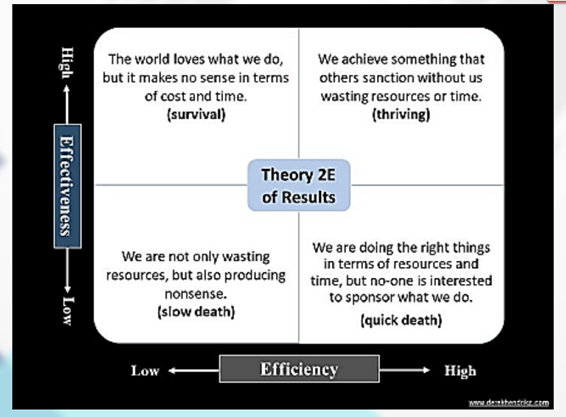
Source: (University of Orgtology)
Corruption undermines both operational efficiency and strategic effectiveness. Operationally, it diverts resources, inflates costs, and reduces productivity. Strategically, it damages reputation, erodes stakeholder trust, and diminishes long-term sustainability (Transparency International, 2023; World Bank, 2020).
When corruption becomes embedded, organisational outputs may initially appear stable. However, over time, performance deteriorates. Resources are misallocated, talented employees disengage, and decision-making becomes distorted by personal interest. Relevance declines as stakeholders withdraw trust.
In orgtological terms, corruption represents a sustained departure from BPE. Efficiency declines because systems are manipulated. Effectiveness declines because leadership intent is corrupted. The organisation continues operating but drifts toward eventual collapse.
Thus, corruption does not exist in isolation. It is a systemic distortion consistent with Hypothesis 2X: every entity exists in duality. Corruption is sustained duality misaligned.
By this, it shows that corruption itself does not exist in isolation as a solitary entity but a system in an organisation which conforms to the theory and science of Orgtology; the Hypothesis 2X that proves that every entity or system exist in duality (Hendrikz, D (2020).
Practical Application: Designing Anti-Corruption Through Orgtology
Applying Orgtology to corruption control implies several strategic interventions:
- Strengthening receptive systems: transparent procurement, segregation of duties, audit rotation, whistleblowing protection, digital tracking.
- Strengthening projective forces: visible ethical leadership, incentive alignment, ethical dialogue, and accountability at senior levels.
- Maintaining equilibrium monitoring: continuous risk assessment to prevent sustained deviation.
- Leveraging the X-Factor positively: encouraging moral courage and protecting those who expose wrongdoing.
SPECIFIC PRACTICAL APPLICATION OF HYPOTHESIS 2X TO CORRUPTION IN NIGERIA’S EDUCATION SECTOR
Nigeria’s education sector provides a powerful case for applying Orgtology to corruption analysis. Despite substantial public expenditure, regulatory frameworks, and oversight agencies, corruption continues to manifest in areas such as admission manipulation, examination malpractice, payroll fraud, procurement inflation, accreditation irregularities, and diversion of intervention funds.
Institutions such as the Federal Ministry of Education, the Joint Admissions and Matriculation Board (JAMB), the Tertiary Education Trust Fund (TETFund), and the National Universities Commission (NUC) operate within formal legal and administrative frameworks. Yet corruption persists across different layers of the sector.
From an orgtological perspective, this persistence demonstrates imbalance between receptive systems and projective human dynamics.
Receptive Dimension: Systems, Rules, and Algorithms
The education sector in Nigeria possesses numerous receptive mechanisms designed to regulate behaviour:
- Centralized admission processing through JAMB.
- Institutional audit requirements.
- TETFund guidelines for project funding.
- Accreditation procedures supervised by the NUC.
- Civil service payroll systems (including digital verification platforms).
On paper, these systems create algorithmic predictability. They are designed to standardise admissions, regulate funding disbursement, and ensure quality assurance. In theory, the repetitive algorithm should reduce opportunities for manipulation.
However, corruption frequently emerges within these very systems. Examples include:
- Admission racketeering through unofficial channels.
- Manipulation of examination scores.
- Ghost workers on payroll.
- Diversion or inflation of TETFund project contracts.
- Falsification of accreditation compliance documents.
These patterns reveal that corruption is not necessarily caused by absence of systems, but by weaknesses in how systems interact with human projection.
Projective Dimension: Leadership, Culture, and Incentives
The projective side of corruption in education includes leadership signals, cultural rationalisations, and incentive distortions.
For instance, when university administrators face pressure to generate internally generated revenue, they may tolerate irregular admission practices. When political actors influence vice-chancellor appointments, institutional autonomy may be compromised. When promotion criteria reward output volume rather than integrity, academic misconduct may increase.
The human X-Factor becomes central here. Individuals interpret systems according to personal incentives, social obligations, and survival instincts. In contexts where unemployment is high and socio-economic pressures are intense, bribery for admission or employment may be rationalised as necessary.
Hypothesis 2X explains that the system alone does not determine outcome; abstract thought projected by humans modifies the system’s function. Thus, admission software may be secure, but insider collusion can undermine it.
Corruption as Breakdown of Dynamic Equilibrium in Education
Best Position Equilibrium (BPE) in the education sector would represent a state where:
- Admission systems operate transparently.
- Funding disbursements follow strict guidelines.
- Accreditation is merit-based and evidence-driven.
- Leadership models ethical behaviour.
- Deviations are detected and corrected early.
Departure from BPE occurs when projective influence overrides receptive safeguards. For example:
- If political influence determines accreditation outcomes, receptive standards lose credibility.
- If audit findings are ignored, accountability mechanisms fail.
- If whistleblowers are victimised, reciprocity collapses.
Over time, this sustained imbalance damages both performance and relevance. Performance declines because resources are misallocated. Relevance declines because public trust in educational credentials erodes.
In extreme cases, degrees lose credibility internationally, employers question graduate competence, and societal confidence in education diminishes. This illustrates how corruption affects both efficiency (internal output) and effectiveness (external legitimacy).
Projecting–Receiving Reciprocity in Educational Institutions
Reciprocity is critical in educational governance. When unethical conduct is projected into the system and not met with corrective response, corruption normalises.
Consider examination malpractice. If a lecturer demands payment for grades and no disciplinary action follows complaints, the receiving mechanism has failed. Students learn that integrity carries cost while corruption yields advantage. Repetition makes the behaviour predictable.
Conversely, when institutions investigate allegations promptly, suspend implicated staff, and enforce sanctions transparently, reciprocity is restored. The system signals that corruption disrupts career progression rather than facilitating it.
This reciprocal reinforcement creates cultural learning. As Argyris and Schön (1978) suggest, organisations evolve when error detection leads to behavioural change. In orgtological terms, such corrective cycles recalibrate dynamic equilibrium.
The X-Factor in the Education Sector
The education sector uniquely amplifies the X-Factor because it deals with aspiration and mobility. Admission into tertiary institutions, scholarship allocation, and employment in academia represent high-stakes opportunities. Human ambition, fear, and social expectation intensify discretionary behaviour.
For example:
- A parent may attempt to bribe an official to secure a child’s admission.
- A lecturer may manipulate grades to secure favour.
- An administrator may inflate project costs to compensate for perceived systemic inadequacies.
These behaviours are not algorithmic; they are abstract and rationalised. Hypothesis 2X explains that unpredictability of human projection creates uncertainty of outcome even when systems are stable.
However, the X-Factor also represents potential reform energy. Reform-minded administrators who digitise admissions, publish cut-off scores transparently, and decentralise discretionary power can significantly reduce corruption. The disruptive capacity of abstract thinking becomes corrective rather than destructive.
Defining BPE for Nigeria’s Education Sector
A Best Position Equilibrium for corruption control in education would include:
- Fully digitised, tamper-proof admission systems.
- Transparent publication of admission lists, matriculation list and funding allocations.
- Independent audit units with reporting autonomy.
- Strict separation between political authority and institutional governance.
- Leadership performance metrics linked to integrity outcomes.
Such equilibrium would not eliminate corruption entirely, but it would constrain it within detectable and correctable boundaries but sustained departure from this equilibrium would involve:
- Politicisation of appointments.
- Suppression of audit findings.
- Informal fee systems.
- Inconsistent enforcement of disciplinary rules.
The longer the departure persists, the more corruption becomes embedded in the organisational algorithm.
Applying the If–Then–Because Hypothesis to Education
Reapplying the hypothesis within this sector:
If Nigerian educational institutions strengthen digital controls, audit independence, and procurement transparency (receptive elements) while leadership consistently projects ethical standards and enforces accountability without exception (projective elements),
then corruption in admissions, funding, and academic processes will be significantly reduced and constrained to manageable levels,
because equilibrium between structure and leadership creates reciprocal cycles that align individual ambition with institutional integrity and long-term educational relevance.
The “Because” mechanism is observable: when both dimensions act in harmony, corruption opportunities shrink and trust increases.
Broader Implications for Sectoral Reform
Applying Orgtology to education reveals that anti-corruption reform must move beyond punitive enforcement. It must:
- integrate system design with ethical leadership.
- reduce excessive discretion without suffocating innovation.
- protect whistleblowers to enhance reciprocity.
- treat corruption incidents as equilibrium warnings rather than isolated scandals.
- continuously recalibrate BPE as environmental pressures change.
Education is foundational to national development. When corruption distorts its processes, the long-term impact extends beyond institutions to national human capital formation.
Thus, the Nigerian education sector demonstrates that corruption is not merely moral weakness but structural-projective imbalance. Sustained equilibrium grounded in Hypothesis 2X offers a scientific pathway toward reform.
Anti-corruption strategy must therefore integrate efficiency and effectiveness. Compliance without ethical leadership is insufficient; leadership without systemic reinforcement is fragile.
A Model Driven Analysis of the Nigerian Education Sector
Understanding corruption within organisations requires a deeper understanding of what an organisation actually is.
In conventional management literature, an organisation is commonly defined as a structured group of people workingtogether to achieve a common objective under defined rules and procedures. For example, the Oxford Advanced Learner’s
Dictionary defines an organisation as “a group of people who work together in an organised way for a shared purpose”(Hornby, 2020). This definition reflects the conventional administrative view of organisations as rule‑based entities governed by formal structures and procedures.
However, this interpretation treats organisations largely as static institutional systems whose primary function is compliance with rules and policies. Such a perspective leaves little room for understanding the deeper dynamics that shape organisational behaviour, particularly the emergence of complex phenomena such as corruption. The discipline of Orgtology offers a different analytical framework for understanding organisational behaviour.
Orgtology, introduced by Hendrikz (2018), can be understood as the science of organisation. The concept combines the word “organisation” with the Greek suffix “‑logy,” meaning the study or science of something. In this context,
Orgtology seeks to study organisations as dynamic systems rather than static bureaucratic structures.
If Orgtology is to be regarded as a science, its theories must be testable, observable, and falsifiable (Hendrikz, 2018).
Within this framework, organisations are not merely collections of procedures but dual systems composed of two interacting dimensions: the receptive and the projective. The receptive dimension consists of the organisational systems, routines, and operational algorithms that govern the daily functioning of the institution.
These include rules, procedures, information systems, and administrative workflows. The projective dimension, on the other hand, represents the abstract and strategic component of the organisation, namely leadership thinking, strategic intent, and human interpretation.
This duality forms the conceptual foundation of Hypothesis 2X, which is the core theoretical proposition within Orgtology. Hypothesis 2X explains how organisations operate through the interaction between repetitive systems and
disruptive human thinking. Through this interaction, organisations generate both predictability and uncertainty, allowing them to sustain efficiency while pursuing relevance.
Understanding corruption through this lens provides a powerful analytical advantage. Rather than viewing corruption simply as individual misconduct, Orgtology allows it to be analysed as a systemic imbalance between receptive systems and projective leadership forces.
This essay therefore applies the theoretical framework of Hypothesis 2X to analyse corruption within organisations, with particular emphasis on the Nigerian education sector. Through a model‑driven analysis, the essay demonstrates how corruption emerges when organisational equilibrium is disrupted and how strategic interventions can restore balance.
THEORETICAL FOUNDATION: HYPOTHESIS 2X IN ORGTOLOGY
Hypothesis 2X represents the core explanatory mechanism within Orgtology. The “2” signifies the dual nature of organisations: the coexistence of receptive algorithmic systems and projective human thinking. The “X” represents the
“X‑Factor,” the unpredictable human element that introduces creativity, discretion, and disruption into organisational systems (Hendrikz, 2019).
Receptive elements are the repetitive operational systems within an organisation. These include rules, procedures, databases, technological platforms, and administrative routines. Their primary function is to ensure consistency and predictability in organisational outputs. Because they are algorithmic in nature, receptive mechanisms tend to produce stable and measurable outcomes.
Projective elements, by contrast, are the strategic and cognitive forces introduced by leadership and human actors.
These include decision‑making authority, interpretation of rules, ethical judgement, and strategic direction. Projective elements disrupt repetition and introduce change into organisational systems.
Hypothesis 2X argues that organisational performance emerges from the interaction between these two elements. When receptive systems dominate without strategic leadership intervention, organisations may become efficient but lose relevance. Conversely, when projective leadership overwhelms systems, organisations may become unstable or unpredictable.
Equilibrium therefore becomes critical. Hendrikz (2020) refers to this optimal balance as the Best Position Equilibrium (BPE). At BPE, receptive systems maintain efficiency while projective leadership ensures relevance and adaptability.
CORRUPTION AS A SYSTEMIC DISTURBANCE
Corruption can be understood within this framework as a distortion of equilibrium between receptive and projective forces. When organisational systems are weak or poorly enforced, individuals may exploit discretionary power for personal gain. Over time, such behaviour becomes embedded within daily organisational routines.
In many organisations, corruption does not emerge suddenly. Instead, it evolves gradually through repeated behavioural patterns. Weak internal controls, lack of transparency, and ineffective oversight can create an environment where unethical practices become normalised.
Within the Nigerian education sector, corruption often manifests through admission manipulation, bribery in grading, procurement irregularities, and favouritism in recruitment. These practices undermine institutional credibility, reduce educational quality, and weaken public trust in the education system.
MODEL‑DRIVEN APPLICATION: A 2X MAPPING OF ADMISSIONS CORRUPTION
To illustrate the application of Hypothesis 2X, this section presents a model‑based mapping of admissions corruption within Nigerian higher education institutions.
Receptive Mechanisms (R):
- Central admission guidelines
- Digital admission platforms
- Institutional admission quotas
- Verification procedures
- Examination result databases
Projective Forces (P):
- University administrators exercising discretionary authority
- Admission officers interpreting admission rules
- External influence from political or social actors
- Financial incentives offered by applicants or intermediaries
X‑Factor Points of Discretion:
- Manual adjustment of admission lists
- Override of automated admission recommendations
- Informal communication between applicants and officials
- Selective application of admission policies
Reciprocity Loop (Loss of Equilibrium)
Step 1: Applicant offers financial incentive to admission officer.
Step 2: Officer manipulates admission list.
Step 3: Applicant gains admission despite weaker qualifications.
Step 4: Lack of enforcement reinforces perception that corruption is acceptable.
Step 5: More applicants attempt similar actions in future cycles.
Monitoring Best Position Equilibrium (BPE)
Operational equilibrium can be measured using indicators such as:
- Percentage of automated admissions decisions
- Number of manual admission overrides
- Frequency of corruption complaints
- Investigation response time
- Number of disciplinary actions taken
Example equilibrium thresholds:
- ≥90% automated admissions
- ≤5% manual overrides
- <2% verified corruption complaints
Restoration Loop After Intervention
Step 1: Complaint submitted through whistle blower system.
Step 2: Investigation triggered through digital audit logs.
Step 3: Responsible officer identified.
Step 4: Disciplinary sanction announced.
Step 5: Behavioural signal discourages corruption.
Conclusion
Through the framework of Orgtology and Hypothesis 2X, corruption can be analysed as a systemic imbalance rather than simply an ethical failure of individuals. By mapping receptive mechanisms, projective forces, X‑factor discretion, and reciprocity cycles, organisations can diagnose corruption dynamics and restore equilibrium.
Corruption within an organisation poses a serious threat to its ethical foundation, operational efficiency, and long-term viability. When corrupt practices become institutionalised, they distort daily algorithm, degrade trust, and erode relevance. Orgtology, through Hypothesis 2X, provides a scientific framework for analysing this phenomenon.
By recognising Org as a dual entity composed of receptive algorithm and projective thought, corruption can be understood as an imbalance in dynamic equilibrium. Sustaining a Best Position Equilibrium requires continuous alignment between systems and leadership. The human X-Factor introduces uncertainty but also provides the disruptive intelligence necessary for correction.
Therefore, corruption control is not merely a compliance exercise but an ongoing organisational design challenge. When equilibrium is maintained, corruption is constrained; when equilibrium collapses, organisational decline becomes inevitable.
References (Harvard Style)
- Hendrikz, D. (2018) Introduction to Orgtology. University of Orgtology Press.
- Hendrikz, D. (2019) Hypothesis 2X and Organisational Duality. University of Orgtology Press.
- Hendrikz, D. (2020) Organisational Equilibrium and Best Position Equilibrium (BPE). University of Orgtology Press.
- Hornby, A.S. (2020) Oxford Advanced Learner’s Dictionary. 10th edn. Oxford: Oxford University Press.
- Hendrikz, D (2020). ‘Hypothesis 2x – the Foundation of Orgtology‘, *The International Orgtology Institute, * 04 April. Available at: https://orgtology.org/…/69-hypothesis-2x-of-orgtology – accessed on 10 May 2020.
- Hendrikz, D (2020). ‘Theory 2I – Understanding Orgtelligence‘, The International Orgtology Institute, 25 September. Available at: https://orgtology.org/…/61-theory-2i-understanding… – accessed on 25 February 2020.
- Hendrikz, D (2019). ‘Theory 2P – Understanding Work‘, The International Orgtology Institute, 14 September. Available at: https://orgtology.org/…/59-theory-2p-%E2%80%93… – accessed on 25 May 2020.
- Hendrikz, D (2019). ‘Theory 2E – Understanding Workplace Results‘, The International Orgtology Institute, 29 September. Available at: https://orgtology.org/…/62-theory-2e-%E2%80%93… – accessed on 13 May 2020.
- Hendrikz, D (2019). ‘Theory O – The Relevant and Performing Organisation (RPO)‘, The International Orgtology Institute, 08 October. Available at: https://www.orgtology.org/…/orgtology-blog/63-theory-o-rpo – accessed on 22 July 2021.
- Hendrikz, D (2020). ‘Theory Ix on Intelligence‘, The International Orgtology Institute, 23 July. Available at: https://orgtology.org/…/71-theory-ix-on-intelligence… – accessed on 24 September 2020.
- Hendrikz, D (2020). ‘Theory Px on Paradigm‘, *The International Orgtology Institute, * 25 November. Available at: https://orgtology.org/…/org…/98-theory-px-on-paradigm… – accessed on 24 September 2020.
- Hendrikz, D (2020). ‘Theory Ex on Identity’, *The International Orgtology Institute, * 09 August. Available at: https://orgtology.org/…/org…/99-theory-ex-on-identity… – accessed on 25 September 2020.
- Hendrikz, D (2020). ‘Theory Dx on the Relevant and Performing Individual (RPI)‘, *The International Orgtology Institute, * 22 August. Available at: https://orgtology.org/…/100-theory-dx-%E2%80%93-the… – accessed on 15 September 2020.
- Argyris, C. and Schön, D. (1978) Organizational Learning: A Theory of Action Perspective. Reading, MA: Addison-Wesley.
- Klitgaard, R. (1988) Controlling Corruption. Berkeley: University of California Press.
- Rose-Ackerman, S. and Palifka, B. (2016) Corruption and Government: Causes, Consequences, and Reform. 2nd edn. Cambridge: Cambridge University Press.
- Transparency International (2023) Corruption Perceptions Index 2023. Berlin: Transparency International.
- World Bank (2020) Enhancing Government Effectiveness and Transparency: The Fight Against Corruption. Washington, DC: World Bank.
By: ABDULLAHI ASHURA