
Leadership as the Linchpin of Equilibrium:
A Study of Organizational Collapse Following the Breakdown of Balance Between Operational Efficiency and Human Ingenuity
By: SANDILE MADOLI DLAMINI
Introduction: A Post-Mortem of a National Asset
The Eswatini Post and Telecommunication Company (EPTC) is a silent testament to the long-burning corporate tragedy. A former pillar of the country’s communication system, it is now one of slow, constant and apparently irrevocable decay — the company’s business coming to an end, its impact waning, its relevance fading into nothingness.
The usual narrative would have blamed this collapse on the external market forces: the current of digitalization or monopoly pressure from private sector titans; the fact of the market; perhaps a shift in consumer behaviour.
However, a simplistic diagnosis of market malignancy masks a deeper and more internal malady from within. EPTC’s demise is the product of a disastrous failure of the management of a crucial element of leadership that ensures the basic level of balance between operational efficiency and human creativity.
Hypothesis Statement: If leadership at EPTC disproportionately directs resources and focus on receptive-concrete activities (operational performance, process alignment, short-term KPIs) rather than projective-abstract activities (human inventiveness, innovation, strategic adjustment), the organisation will ultimately suffer decline of long-term relevance, and hence of performance, as the “balance” required by
Hypothesis 2x is broken, leading to a vicious circle of organisational entropy within the organisation, where force of entropy (FOE) exceeds TEIP (Intent, Energy, Intelligence, Purpose).
For this purpose, Hypothesis 2x from Orgtology (Hendrikz, 2019) is employed for assessing the degradation of EPTC, which through a combination of tests and empirical evidence can be verified to indicate that EPTC failed not because of market position but of leadership philosophy, a limited focus on short-term performance that consistently snuffed out the innovative force required to survive and be a sustainable organisation.
Now that we have confirmed this diagnosis, we will turn to applying some prescriptive thinking into future situations to see what a new approach to leadership based on Orgtological principles might find elsewhere to bring EPTC back to a resurrection on a phoenix scale at the very least Method and Argument Structure: This paper is organized as follows. First, Best Position Equilibrium (BPE) for EPTC is set forth in measurable terms. Second, I use three Orgtology theories—Theory 2I (Orgtelligence), Theory 2E (Results) and Theory O (The Relevant and Performing Organisation)—to diagnose the asymmetry.
Third, I trace EPTC’s phased destruction through the FOE > TEIP framework. Fourth, I test a counter-example (Deutsche Post DHL) and test of relative failure (Nokia) to show support for the conjecture. Finally, I propose a renewal strategy based on the three constructs of Hypothesis 2X: process, project, and relationship
Defining Best Position Equilibrium (BPE) for EPTC
In Orgtology, Hypothesis 2X assumes that since there are only two elements, the alliance between receptive and projective must be present if an organisation is one (Hendrikz, 2019). But equilibrium is not an equibile point to fix the position of its component parts, but a dynamic condition. Best Position Equilibrium (BPE) refers to the situation when receptive and projective forces are balanced out so that neither force is dominant enough to cause organisational harm. For EPTC, “Best Position Equilibrium” is given as:
- Minimum level of stability in operations (receptive): Old mail and landline services bring in enough cash-flow to pay for their direct cost, do not need to be subsidised across the board or are suffering operational losses.
- Minimum level of innovation pipeline (projective): A minimum of at least two active projects (the former, e.g., digital addressing to facilitate last mile e-commerce logistics, the latter, for example secure cloud storage for the smaller end-users), in development and both of which are currently or will continue to be funded by stage-gate reviews at a minimum and, when at the same time, funded.
Departure indicators (instances of imbalance (imbalance evidence):
- Innovation throughput = Zero – no new service introduced in 24 months; no new service launch in a row.
- Process compliance > 90%, while market share falls year to year.
- Project budget provisioned with less than 5% of company-wide operating budget in two years running.
- Stakeholder reciprocity failure – government demands KPIs yet denying strategic autonomy of decision-making, leadership does not project a plausible narrative of transformation.
Restoration actions: Invest more with 15-20% of opex; set up a protected innovation unit reporting directly to the board; negotiate the nature of the government relationship for independence and transparency, driven by the data.
Leader as the Architect of Balance.
To do so, the leader in an established business must go above command and control. The latter function is put more simply through Orgtology’s Hypothesis 2x, which defines the organisation as a dynamic alignment of dualities (Hendrikz, 2019). On one side the Operational Efficiency, the receptive-concrete force.
Thus, we have standardised processes, predictable outputs, and cost control, the field of processes. It provides a guarantee of current viability, profitability, and stability, thus answering the question “Are we doing things right?” For EPTC, this meant maintaining landline networks, taking in mail and reporting on government-mandated Key Performance Indicators (KPIs).
In contrast, human ingenuity, that projective abstract thing, or what Orgtology calls the X factor (Hendrikz, 2019), exists elsewhere. The reason humans are so unpredictable, because if they were to not generate infinite possibilities they would not be a solution to every single problem in the world.
This is what it is like to imagine, create, challenge norms and forge adaptation with human intellect. It provides the answer to the question “are we doing the right things?” for the future with innovation and strategic renewal. This would have been EPTC’s vehicle in creating new digital services or testing fintech, or re-inventing itself in a connected Eswatini.
It is the key argument, then, that a leader’s main obligation must not be to mediate between them, or in other words, to choose between them, but to be the custodian of their equilibrium. In Orgtology, leaders are understood to champion project-based work (which entails change, innovation, and adaptation) whereas managers are seen as providing process-based work (which ensures continuity and consistency) (Hendrikz, 2019).
So the powerful leader ensures that the engine of operational efficiency does not run so heavily that it crushes the fragile but necessary fire of human creativity. They are the builders of orgtelligence—the fusion of human intellects and systems intelligence which constitutes the basis for survival and development (Hendrikz 2019). Having a leader who fails to walk this line is not a strategic error but an abdication of the strategic role.
Theories of Orgtology Used to Diagnose Imbalance in EPTC.
Theory 2I: Orgtelligence and Rationality Continuum.
Theory 2I (Intelligence) of Orgtology brings the Rationality Continuum (Hendrikz, 2019). Human rationality can never match the rationality of algorithmic systems, and artificial intelligence can never be the irrationality of a human abstraction. And together they make organisation possible: rationality underpins process efficiency and performance; irrationality underlies change through vision, innovative endeavour, emotion and dreams.
In EPTC, systems intelligence prevailed through its set KPIs, automated network monitoring and budget controls. Human intelligence was repressed: engineers with fibre-to-the-home pilot ideas or digital payment integrations were advised to “focus on your existing targets.” When human and systems intelligence are working hand in hand, they can drive orgtelligence, with systems that promote precision and efficiency, and humans that promote adaptability, creativity, and relevance (Hendrikz, 2019).
At EPTC, the outcome was not orgtelligence but systems hypertrophy—strong body with dull mind. The Rationality Continuum was total collapse, heading toward the rational pole of thinking and nothing existed which facilitated this abstract, irrational, projective thinking necessary for innovation.
Theory 2E: Efficiency VS. Effectiveness.
Theory 2E (Results) formalises the duality between efficiency (doing things right) and effectiveness (doing the right things). An organisation will struggle to perform without relevance (effectiveness) because energy and time will be spent chasing sponsorship, approval, or acceptance. Without operational efficiency, an organisation will be unable to run properly and financially survive (Hendrikz, 2019).
EPTC turned into hyper-efficient mailers and copper line maintainers. Cost-cutting initiatives, process optimization, and lean staffing all positively impacted on efficiency metrics. But the organization became deeply ineffective as its core services lost relevance. Efficiency sustains an organisation, but effectiveness advances it. Both are necessary and neither can replace the other (Hendrikz, 2019).
EPTC’s management clung tightly to efficiency as if it were a replacement for effectiveness, a mistake that was utterly fatal. When mail volume plummeted despite perfect on-time delivery stats, Theory 2E’s prediction was proved true: efficiency, without effectiveness is ultimately of no value.
Theory O: The Relevant and Performing Organisation (RPO).
Theory O states that TEIP > FOE is the formula; wherein TEIP is Intent, Energy, Intelligence and Purpose and FOE is the Force of Entropy (Hendrikz, 2019). All businesses operate in an organic universe of time, matter, and space and a relentless force in a matrix of opposition – Force of Entropy.
To ensure that any organization survives the TEIP must be greater than the FOE (Hendrikz, 2019). For EPTC, the TEIP was gradually undermined:
Intent became narrow; it was reduced to ‘hitting government performance targets’ rather than the projective spirit of boldly doing what has never been done before (Hendrikz, 2019).
- Energy (resources) was misallocated—almost entirely directed to process maintenance, with no ring-fenced project funding.
- Intelligence became systems-only — human knowledge was suppressed and orgtelligence was shattered.
•Purpose; was no longer to do any good to our nation but rather to survive.
FOE, meanwhile, mushroomed. In the public sector context, FOE manifests itself as loss of confidence of public sector taxpayers in the government (Hendrikz, 2019).
For EPTC, there was also competition from MTN, WhatsApp, and private couriers but with diminishing public confidence in a service provider considered obsolete. When the FOE crossed TEIP, it became mathematically guaranteed to collapse.
Broken Reciprocity: How EPTC’s Stakeholder Relationships Decayed
Hypothesis 2X posits that an organisation exists through the combination of receptive and projective elements. This is not only an organizational alliance.
The concept includes its stakeholders as well: it extends to those relations of relationship-making through what Orgtology refers to as both projecting and receiving cycles (Hendrikz, 2019). In its projecting, an organisation tries to do what it knows it’s never done before. If it is receptive, it faithfully repeats and sustains what is already known.
Cycle 1: EPTC ↔ Citizens/Customers.
EPTC projected (provided) a low-cost, dependable communication service. Citizens received (used) and projected back revenue and loyalty. When EPTC stopped offering their innovative offerings—no mobile data solutions, no digital services, no adaptation to the WhatsApp era—people stopped coming, switching to private competitors.
The cycle was broken because a completely receptive EPTC (doing the same thing over and over) stopped projecting anything new.
Cycle 2: EPTC ↔ Government Shareholder.
Government projected funding, regulatory protection and strategic mandate. EPTC got these, however, and reported back performance reports and political compliance. Yet when the government projected interference, revoking restructuring, mandating unprofitable services, demanding short-term KPIs—apart from clear strategic justification from EPTC, both sides became passively receptive dominants of the relationship.
Both demanded submission from one another, and neither delivered trust or strategic autonomy. Leadership’s role is to oversee both the complicated and the straightforward aspects of an organisation, and to make sure that each is serving the other well (Hendrikz, 2020).
EPTC’s leadership fell completely victim to poor governance and its failure to manage the relationship between the government and the EPTC leadership.
The Seductive Trap of Short-Term Performance.
Why would a leadership team, charged with ensuring the well-being of an organisation’s future, intentionally ignore the force that guarantees it? The case of EPTC shows the power of the receptive-concrete trap. For a state-owned business, the pressure for results — clear, reportable results — is enormous.
The government, a major shareholder, insists on accountability based on tangible metrics: quarterly financial statements, figures on the uptime of the network, and conformance to budgetary constraints. These measures are overwhelmingly receptive; they assess how good what already exists.
At EPTC, leaders were rewarded for maximising the use of this existing machinery. Operating at scale — squeezing further life from the copper-wire network, reducing the cost of delivering mail, yielded immediate, visible results that satisfied stakeholders. That focus was further compounded by scarce resources; every lilangeni invested in a speculative, projective project (such as a new digital platform) was a lilangeni not spent to maintain the immediately profitable (but declining) status quo.
The organisation’s purpose (a receptive component) was therefore narrowly defined to “achieve our performance targets for government” and completely eclipsed the projective impulse to “boldly undertake what has never been undertaken” (Hendrikz, 2019).
This formed a dangerous cycle. Executives were lauded for controlling efficiency, confusing short-term performance with long-term strategic well-being. The achievable, measurable was lost in what mattered. In doing so, they fell to the trap, creating a hyper-efficient organisation finely tuned to a world of accelerating global obsolescence.
The Silent Death of innovation: Consequences of Imbalance
There are no simple strategic miscalculations that come with a preference for efficiency over ingenuity that can be traced back the years rather than simply in individual organisations, but the cultural and systemic poison they contribute to undermining a person’s ability to live.
The systems designed for optimal operational efficiency are intrinsically antagonistic to the facets of human ingenuity. This relationship is explored by Orgamatics, a subfield of the field of Orgtology, who demonstrates how a strict “mathematical structure” will crush the “infinite possibilities” in human thinking (Hendrikz, 2019). This took the form of multiple manifestations at EPTC:
- Stifled Creativity: Employees’ ideas for new digital services or process innovations met with resistance. When new approaches were proposed, they were suffocated by very risk-averse bureaucracies; their business cases could not come up against the clear business benefits of incremental efficiency gains.
- Reduced Risk-Taking: Taking calculated risks—the lifeblood of innovation—became a career liability in a culture where deviation from process was actively punished. The “projective” spirit to explore and create was systematically tamed.
- Erosion of Adaptive Potential: The human mind should be able to free itself to be able to think at a higher level with what needs to be done; problem solving, vision generation, strategic formulation (Hendrikz, 2019). When human ability was linked to preserving what was already out there, EPTC let its adaptive muscles atrophy. When the market changed, it lost the internal ability to react.
The nature of chaos or order is totally contingent upon how useful something is to the entity experiencing it. In Orgtology, these are not states and facts without context, purpose, and intention (Hendrikz, 2019). EPTC was a place where chaos, which would generate innovation, was perceived as a disruptive threat to order instead of an opportunity for rebirth.
The orgtelligence circuit was gone. Systems intelligence was king, human intelligence was repressed. The organisation was working, but it was now dead and not learning or changing. It was operating well into irrelevance.
The Collapse: Tracking EPTC’s Fall from FOE to TEIP.
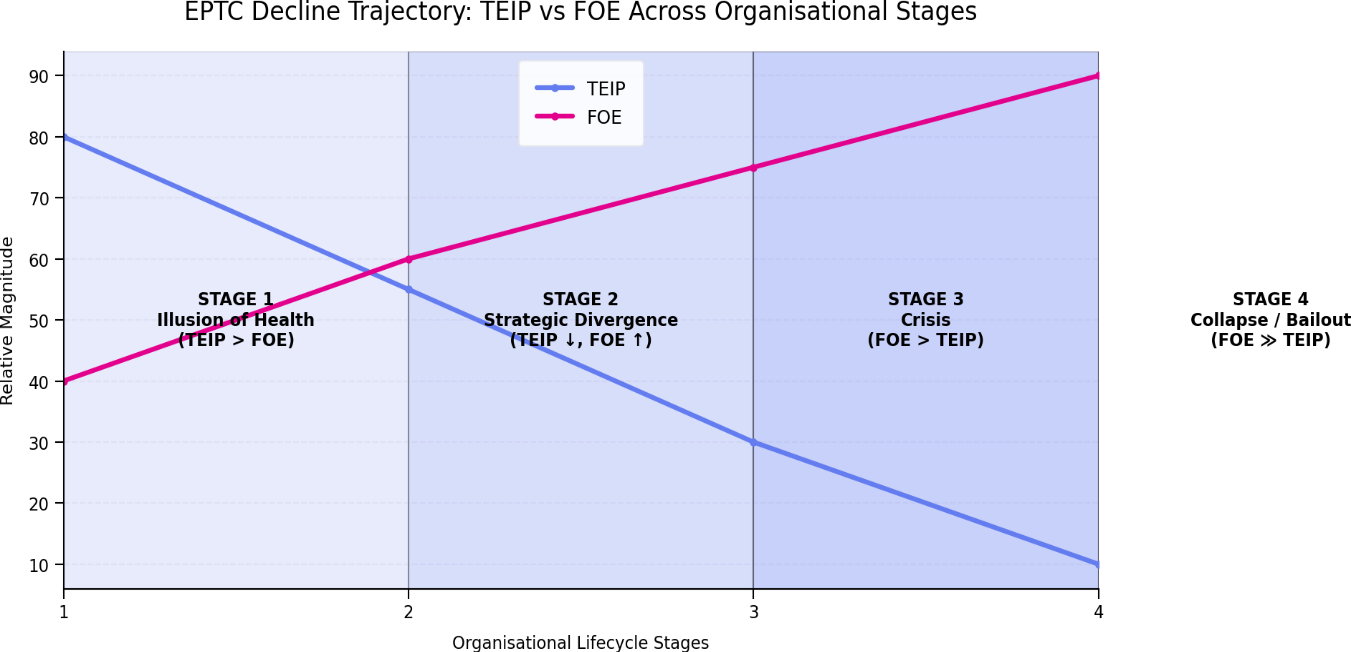
The real culprit behind organisational failure is revealed through a cyclical approach; a journey that becomes apparent in light of Hypothesis 2x and Theory O, and the formula TEIP > FOE serves as the diagnostic tool: collapse happens where FOE surpasses TEIP (Hendrikz, 2019).
Stage 1: Illusion of Health (TEIP moderately > FOE).
EPTC got started early in high performance and paid attention to its initial mandate. The organisation was viable, operating efficiency was strong. TEIP was fine: intent was clear (national communication service), Energy was sufficient, Intelligence was balanced (systems + human), and Purpose was meaningful.
Stage 2: Strategic divergence (TEIP decreasing, FOE increasing)
As market shifts sped up (the advent of mobile telephony, digital messaging, WhatsApp), decisionmakers doubled down on efficiency (receptive) and neglected projective ingenuity. Relevance started to come under pressure, but performance reports continued to seem good due to cost cuts and monopoly positions. This was the pivotal point of imbalance.
TEIP began to erode as intent narrowed, Energy was wasted and human intelligence was squelched. FOE (competition, obsolescence) increased.
Stage 3: Crisis (FOE begins to surpass TEIP).
The decay became external. Market share evaporated, revenue collapsed, and any “performance” built on a ruinous bedrock crumbled. The organisation was in what felt to be a visible crisis, trying to catch up with trends that it hadn’t planned ahead to.
The latter will make it impossible for an organisation to be successful, as time and energy will be consumed pursuing sponsorship, approval or acceptance (Hendrikz, 2019e).
Stage 4: Collapse or Bailout (FOE >> TEIP)
This meant the organisation had reached a point of terminal decline. It was now transferring its operational efficiency to a no longer relevant business model. It couldn’t perform, and it was not relevant. TEIP was a fraction of FOE. The end result was a collapse, closure or the perennial state of government bailouts — a drain on national resources, more than a contributor.
For EPTC here it follows its evolution from strengths to untangle to state of disarray. It sealed its fate when the leadership could not bring projective, innovative energy at Stage 2—to rebalance the dualities. They handled the steep decline of their existing business well but failed to build a new one.
Comparative Validation: Nokia Vs. Deutsche Post DHL.
The Nokia Warning
Imagine the fate of Nokia’s mobile phone division, a once powerful global leader whose market share disappeared in the late 2000s. Its downfall is often seen, externally, at times, in hindsight as a result of a disruptive rise of Apple’s iPhone and the Android ecosystem. However, a deeper Orgtological analysis shows us the same image with a familiar pattern: leadership ensnared in the receptive-concrete mechanisms of historical success as seen in the successful example of its own past successes.
At its peak, Nokia was an absolute powerhouse as a technology company, managing supply chains, reducing production costs and fine-tuning hardware on a massive scale. Its leadership got ahead by optimizing this incredibly powerful machine, carefully
stewarding the performance of a known world. But this too was a focus on perfecting the current model, engendering a cultural and strategic blindness.
The initial internal prototypes of touch-screen smartphones were muted, not because its engineering team lacked human savvy but because the company’s leadership style favored the steady, high-margin bottom line returns of the existing Symbian-powered product line over the projective, unknown bet of investing in a reimagined future. The goal of the organisation turned: “winning in the feature phone market,” overshadowing the “projective intention” of defining the smartphone age altogether.
Nokia’s story powerfully highlights that even the most efficient operational engine, when cut loose from the projective will of human invention, doesn’t just slow down-it plunges the organisation off a strategic cliff. But the market did not kill Nokia; it simply exposed the disastrous impact of a business leadership who no longer served its duty to keep that balance.
The Deutsche Post DHL Counterfactual.
The different case of Deutsche Post DHL Group gives us a master class of leadership maintaining the Orgtological equilibrium. Faced with a similar threat—traditional mail going out the window as digitalisation took over—its leadership did not only optimise the old. To take the company and re-establish its very purpose made a conscious, projective choice. What they foresaw was a future as a global logistics behemoth, powered by human creativity.
Importantly for this projective approach was not done at the expense of efficiency. To realize the vision, the leadership also developed a top-of-the-line operational backbone — the processes, logistics networks and IT systems (also known as receptive elements). They adhered to the two-in-one nature of Hypothesis 2x: employing human intellect to create a fresh strategy (effectiveness) and systems intelligence to execute it quickly. They juggled giant, seismic projects (acquisitions, brand integration) and hyper-efficient operations inside their warehouses and delivery routes.
This considered handling of both forces helped them navigate the industry transition well and became more relevant and profitable than they could have ever done.
A Prescription for Phoenix-like Resurrection: Applying the Constructs to EPTC
Thus far, the analysis does paint a grim picture for EPTC, but Orgtology principles are not only diagnostic; they are also prescriptive. The three constructs of any organisation are described in Orgtology—process, project and relationship, and the application of Hypothesis 2X is implemented on a practical level according to how the theory is applied (Hendrikz, 2020).
As advanced as EPTC is in its slow death, collapse is not the only danger if leadership is able to reintegrate these dualities relevantly.
Construct 1: Process (Receptive Efficiency as Fuel).
First, leadership needs to step up operational efficiency, but not as an end in itself. Instead, it needs to be recontextualized as the catalyst for projective creativity. To draw on a key human evolutionary lesson, Orgtology points out that there must be automation as processes must operate in ways, similar to how the body’s internal systems work automatically without any conscious effort (Hendrikz, 2019). That includes ruthlessly simplifying the structure and service offerings of the organization.
EPTC needs to have a “serious evaluation” of its services. Can the legacy mail service be dramatically scaled down or work with private couriers to offset losses? Can the maintenance of the copper-line network be automated or outsourced to free up capital?
The savings generated from this hyper-efficient management of the “old” business must then be explicitly and courageously ring-fenced to fund the “new.” This is the essence of balancing the receptive and projective: using the stability and cash flow from processes to fund the potential of projects.
Construct 2: Project (Projective Ingenuity as Renewal).
EPTC in the modern-day world now needs to invest in the very digital and AI technologies that disrupted the way they operate. For instance, EPTC would create a national digital addressing system, convert all of its big physical facilities into a last-mile delivery node for e-commerce companies or draw on its legacy telecommunications business base to provide low-cost secure cloud storage services for Swati SMEs and government data.
Within Orgtology, the higher one moves in an organisational hierarchy, the more his or her work is project-based or strategic, future-oriented, innovative (Hendrikz, 2019). Both EPTC’s board and senior leadership, now must change from a management mindset to a leadership mindset — driving projects, instead of approving processes.
That means establishing fortified spaces: innovation labs, cross-functional group projects, or corporate venture arms where project forces are both permitted and required to disrupt the status quo.
Construct 3: Relationship (Managing the Government Stakeholder)
For the organisation to be transformed successfully, its leadership need to be skilled in mastering the relationship construct. The interference of the government and its influence—such as halting a restructuring which was necessary—is not just a matter of politics; this construct has failed management. It is entirely too great to rely on.
The leadership should not be positioned solely within the organisation; it should also be involved in the anticipatory and effective management of its most significant stakeholder relationship.
But rather than problematise the government, they need to portray an exciting, data-driven vision of the future. This is employing their human mind to create a new story. Instead of restructuring with the prime purpose of job cuts—which would be bad news—they need to develop a ‘Transformation and Future-Relevance Strategy,’ which makes that duality explicit: “In order to save the viable core of the organisation, and thousands of jobs over the long term we need strategically to divest from these legacy areas but invest in these future-proof digital domains.”
The current path leads to a total, state-funded bailout. These are not, however, the only options but as a proposed path toward a self-sustaining, modern national asset.
Orgtology teaches that one cannot change another person directly. What one can do is influence the paradigm, or viewpoint that is held in order to change the world, that is their view of it (Hendrikz, 2019).
The key is to guide EPTC’s management at the government level through the paradigm shift in the government from the micromanaging of processes to a purposeful and intent-driven celebration of the goal and goal-driven focus to be the ultimate result, of purposeful and purposeful thinking at EPTC. That takes enormous political art and courage, but it is mandatory.
Conclusion: The Decision to Manage a Transformation or Manage a Decline
Eswatini Post and Telecommunication Company can be seen as a lesson in organizational dynamics, but it need not be its dying epitaph. Its slide to collapse was never a simple result of market forces, but a natural outgrowth of a leadership failure to maintain the dynamic balance Orgtology’s Hypothesis 2x requires; for by tripping over the receptive-concrete trap, EPTC leaders put the cold efficiency of a dying paradigm ahead of the warm, unkempt, and life-giving spark of human ingenuity.
And they were short-term efficient at the cost of long-term relevance—a trade-off that, in the end, is fatal.
This hypothesis is confirmed when it is concluded that “when leadership allocates resources disproportionately as receptive-concrete activities and at the expense of projective-abstract activities, the company experiences measurable decline, as the dynamic equilibrium necessary for the conclusion obtained for hypothesis 2X is disturbed, leading to FOE > TEIP”.
EPTC’s indicators of departure—zero innovation throughput, process compliance greater than 90% during market decline, project budget less than 5%, stakeholder reciprocity failure—are all consistent with such a diagnosis.
But the prescription for resurrection shows, leadership is the lifeblood still holding it together. Yet if you think about it the way forward, while not without its difficulties, is clear. It requires a courageous duality—the will to adopt ruthless operational efficiency into legacy systems not as an end goal, but also as the basis to finance projective innovation in digital- and AI-driven domains. It requires a political-strategic master hand at producing what is known as the relationship construct.
We must be on the way to turning the government from a micromanager toward modern strategic partners—from building something bad again as done for a long time before into a national asset that has futureproofed itself.
Leadership is viewed as a temporary intervention, while management is a permanent state of being in Orgtology. A Relevant and Performing Individual plays a critical role in knowing when to come out onto the field as a leader and when to take the sideline as a manager (Hendrikz, 2019).
Now it is time again for EPTC’s leaders to hit the field. EPTC’s story is a national warning, but it may yet become a national lesson in resilience. Equilibrium itself now needs to stand as an architect of renewal.
Reference List
- Hendrikz, D (2020). What is Orgtology?, The International Orgtology Institute, 12 April. Available at: https://orgtology.org/index.php/2015-06-01-09-45-25/orgtology-blog/68-what-is-orgtology
- Hendrikz, D. (2019) ‘Duality-an Orgtology perspective’, The International Orgtology Institute, 04 September. Available at: https://orgtology.org/index.php/2015-06-01-09-45-25/orgtology-blog/56-duality-of-orgtology.
- Hendrikz, D. (2019) ‘Orgtology and the X-Factor: Human intelligence in organisational systems’, The International Orgtology Institute.
- Hendrikz, D. (2019) ‘Leadership, management, and the hierarchy of work’, The International Orgtology Institute.
- Hendrikz, D. (2019) ‘The Rationality Continuum and the six applications of intelligence’, The International Orgtology Institute.
- Hendrikz, D. (2019) ‘Efficiency and effectiveness: The duality of results’, The International Orgtology Institute.
- Hendrikz, D. (2019) ‘Theory O-The Relevant and Performing Organisation (RPO)’, The International Orgtology Institute, 08 October. Available at: https://www.orgtology.org/index.php/2015-06-01-09-45-25/orgtology-blog/63-theory-o-rpo.
- Hendrikz, D. (2019) ‘Purpose, intent, and the projective-receptive duality’, The International Orgtology Institute.
- Hendrikz, D. (2019) ‘Paradigm and transformation in organisations’, The International Orgtology Institute.
- Hendrikz, D. (2019) ‘The dual role of manager and leader’, The International Orgtology Institute.
- Hendrikz, D. (2020) ‘What is Orgamatics’, The International Orgtology Institute, 26 April. Available at: https://orgtology.org/index.php/2015-06-01-09-45-25/orgtology-blog/70-what-is-orgamatics-1.
- International Transport Journal (2025) ‘Deutsche Post has been a public limited company for 30 years’, International
- Transport Journal, 7 January. Available at: https://transportjournal.com/2025/01/07/deutsche-post-has-been-a-public-limited-company-for-30-years/
- Alcacer, J., Khanna, T. and Furey, M. (2011) ‘Nokia: The Burning Platform’, Harvard Business School Case 711-514. Available at: https://www.hbs.edu/faculty/Pages/item.aspx?num=40460
By: SANDILE MADOLI DLAMINI